
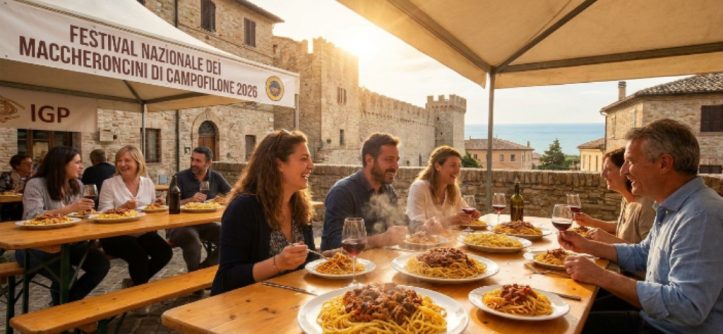
Tucked into the hills of the Marche region in central Italy, a tiny medieval village does something extraordinary every August. It fills the night air with the scent of slow-cooked ragù, strings of lights, and live music. Thousands of people travel from across Italy and beyond to sit at long wooden tables, share plates of gossamer-thin egg pasta, and celebrate a culinary tradition that stretches back more than six hundred years. In 2026, this beloved ritual returns for its 63rd edition, and it is more reason than ever to plan a journey to one of Italy’s most quietly extraordinary places.
Dates, Location and Essential Details
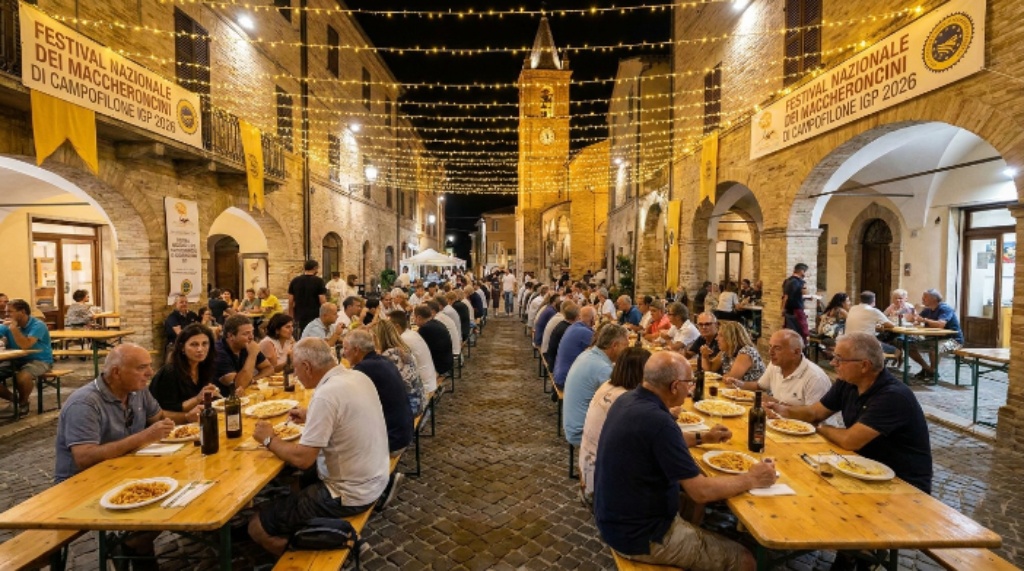
The 63rd National Festival of Maccheroncini di Campofilone IGP will take place from August 7 to 10, 2026, in the village of Campofilone. The festival is held on Via 20 Settembre, the main street of the village, which transforms each evening into an open-air dining experience unlike anything else in Italy.
Doors open each evening at 7:00 p.m., when pasta distributions begin. Entertainment follows later into the night, with live music performances starting at 10:00 p.m. on each of the four evenings.
Campofilone sits in the province of Fermo, in the Le Marche region of central Italy, perched on hills overlooking the Adriatic Sea. The nearest major towns are Porto San Giorgio and Fermo, both within easy reach by car. The closest railway station is at Porto San Giorgio, which connects to Ancona, Pescara, and Rome along the Adriatic coastal line. Therefore, the festival is accessible even for visitors traveling without a car, though renting one is recommended for full flexibility in exploring the surrounding region.
The Pasta That Made a Village Famous
To understand the festival, you first need to understand the pasta itself. Maccheroncini di Campofilone are made exclusively in the territory of Campofilone, a small medieval village in the province of Fermo. The pasta ranges in length from 35 to 60 cm, with a maximum thickness of 0.7 mm. What sets it apart from virtually all other pasta in the world is the extraordinary quantity of eggs used: from a minimum of 7 to a maximum of 10 eggs per kilogram of durum wheat semolina or double-zero flour, roughly twice as much as other egg pasta types.
No water is added at any stage. The dough is prepared with quality hard wheat flour and fresh eggs, without the addition of water. It is laid out into thin sheets and then cut into fine strings to dry on specific sheets of paper. The thinness of the dough, between 0.3 and 0.7 mm, and the very fine cut, between 0.8 and 1.2 mm, give the pasta unique qualities and allow for an extraordinarily quick cooking time of just one minute in boiling water.
The result is a pasta of brilliant golden color, silky texture, and remarkable delicacy. It is sometimes called capelli d’angelo, or angel hair, though even the finest commercial angel hair pasta is thick by comparison.
A Six-Hundred-Year-Old Tradition
This pasta has deep roots. Campofilone’s pasta-making tradition began according to popular gastronomic legends written as early as 1400, where a particular recipe mentions ‘Maccheroncini fini fini.’ The first certain documents referring to this pasta date back to the Council of Trent in 1560, where it is described as ‘so thin that it melts in the mouth.’ Even the poet Giacomo Leopardi mentions it among his favourite dishes of Marche cuisine.
The origin of this product is rural. Farmers’ families of Campofilone used the eggs of their own free-range hens, mixed with flour. The resulting sfoglia was cut into very thin strings, dried, and kept all year round. This technique allowed families to preserve an egg pasta supply throughout the year, well before refrigeration made food storage easy.
However, the pasta remained largely a local secret for centuries. Its commercial rise came much later. In 1965, Nello Spinosi, with his artisanal enterprise Alimentari Valdaso, made the first packaged version for sale, beginning the wider diffusion and commercialization of Campofilone pasta. His son Vincenzo later took it global, cooking maccheroncini on board the Concorde and introducing it to international audiences.
In 2013, Maccheroncini di Campofilone received Protected Geographical Indication recognition from the European Union, making it the only Italian egg pasta to hold this prestigious certification. The PGI status confirms the authenticity, quality, and strict geographic origin of the product according to EU standards.
The Festival Experience: What Happens Each Evening
The festival is organized by the Pro Loco Association of Campofilone, with collaboration from the local municipal administration. It has run every summer since 1964, making the 2026 edition the 63rd consecutive celebration of this community’s greatest culinary treasure.
One of the most characteristic moments of the festival is the pasta service itself. The pasta, cooked in just over a minute, is placed on wooden tables and vigorously tossed with ragù. This process allows the maccheroncini to better absorb the sauce, guaranteeing an excellent result in terms of taste.
Each evening, visitors order plates of maccheroncini al ragù di carne, the canonical preparation with a slow-cooked meat sauce. The festival menu also traditionally includes frittura mista: stuffed olives all’ascolana, fried custard cream, and french fries. These are the classic accompaniments that round out an evening of Marche cooking at its most generous.
Additionally, the four evenings feature live music performances that keep the atmosphere lively well into the night. The village street becomes a dining room, a concert venue, and a community gathering place all at once. Artisan craft markets and cultural exhibitions fill the surrounding spaces, giving visitors plenty to explore between courses.
The Ragù: A Sauce Worth the Journey Alone
The pasta is extraordinary, but the sauce is its equal. The typical Campofilone recipe calls for the pasta to be dressed on a wooden board that retains excess cooking water, with a red ragù of mixed meats including beef, pork, and Muscovy duck.
This Marchigiano ragù is considered a rival to Bolognese sauce. The key difference lies in the wider mixture of meats. Recipes can include a combination of veal, beef, chicken pieces and giblets, pork meat and ribs, sausages, and sometimes even duck meat. Many recipes also add a beef marrow bone to the sauce, which is simmered for two to three hours over low heat until deeply flavored.
The result is a layered sauce that clings perfectly to the gossamer threads of pasta. When the two meet on the wooden board, the pasta absorbs the sauce almost immediately. It is the kind of eating that is difficult to describe and impossible to forget.
Getting There and Planning Your Visit
Campofilone is a small village, and August is a popular month throughout Le Marche. Planning ahead makes a significant difference to the quality of your experience.
The nearest accommodation options are in Porto San Giorgio, a seaside town about ten minutes by car, and in Fermo, the elegant hilltop provincial capital. Both offer a range of hotels, B&Bs, and apartments. Booking several weeks in advance is strongly recommended for any stay during the festival dates.
If you are driving, the A14 Adriatica motorway runs along the coast, with exits at Porto San Giorgio and Civitanova Marche. From either exit, Campofilone is a short drive inland through the rolling hills of the Fermano.
The festival opens each evening at 7:00 p.m., and queues for pasta can build quickly in the first hour. Arriving early gives you the best chance of a comfortable seat and a shorter wait. Bring cash, as smaller Italian village festivals often prefer it over card payments, though it is worth confirming this closer to the date through the official Pro Loco Campofilone channels.
Take time to explore the village itself before or after dinner. Campofilone has medieval walls, quiet lanes, and views across the Adriatic that make it one of the most beautiful small towns in Le Marche. The pasta shops are also worth a visit during the day, where you can buy boxed maccheroncini to take home as one of the finest food souvenirs Italy has to offer.
Conclusion
The 63rd National Festival of Maccheroncini di Campofilone IGP runs from August 7 to 10, 2026, in the medieval hilltop village of Campofilone in the Le Marche region of central Italy. Every evening from 7:00 p.m., visitors gather at long wooden tables to eat plates of gossamer-thin egg pasta tossed with slow-cooked Marchigiano ragù, accompanied by fried olives, custard cream, and live music under the stars. The pasta itself is one of Italy’s most extraordinary food traditions, made with an unusually high proportion of eggs, no water, and a maximum thickness of 0.7 mm, earning it a PGI certification in 2013 and the distinction of being the only Italian egg pasta to hold this European protection. The festival has run continuously since 1964 and is organized by the local Pro Loco Association. Whether you are a devoted food traveler, a pasta enthusiast, or simply someone who loves an Italian village in August, this is an experience that earns its place on any Italy itinerary.
Frequently Asked Questions
When exactly does the 2026 festival take place?
The 63rd National Festival of Maccheroncini di Campofilone IGP runs from Friday, August 7, through Monday, August 10, 2026. Each evening begins with pasta distributions at 7:00 p.m. and live music from 10:00 p.m. The festival takes place on Via 20 Settembre in the village of Campofilone, province of Fermo, Le Marche, Italy.
What makes Maccheroncini di Campofilone different from other pasta?
This pasta is made with an unusually high ratio of eggs to flour, between 7 and 10 eggs per kilogram, and no water whatsoever. The resulting dough is rolled to a maximum thickness of 0.7 mm and cut into extremely fine threads. It cooks in as little as one minute, has a rich golden color, and a melting texture that is unlike any other pasta. It is the only Italian egg pasta to hold Protected Geographical Indication status under EU law, awarded in 2013.
What food is served at the festival?
The main dish is maccheroncini al ragù di carne: the pasta dressed with a slow-cooked mixed meat sauce made from beef, pork, and sometimes duck. The traditional menu also includes frittura mista, which features stuffed Ascolana-style olives, fried custard cream, and french fries. All food is prepared and served by the local Pro Loco Association of Campofilone.
How do I get to Campofilone?
By train, the nearest station is Porto San Giorgio on the Adriatic coastal line, which connects to Ancona, Pescara, Bologna, and Rome. From Porto San Giorgio, Campofilone is approximately ten minutes by car or taxi. By road, take the A14 motorway and exit at Porto San Giorgio or Civitanova Marche, then follow signs inland toward Campofilone.
Where should I stay for the festival?
The closest towns with accommodation are Porto San Giorgio, a seaside resort about ten minutes by car, and Fermo, the elegant hilltop provincial capital roughly fifteen minutes away. Both offer hotels, B&Bs, and holiday apartments at various price points. Booking well in advance is essential for August dates, as Le Marche is a popular summer destination throughout Italy.


Leave a Reply